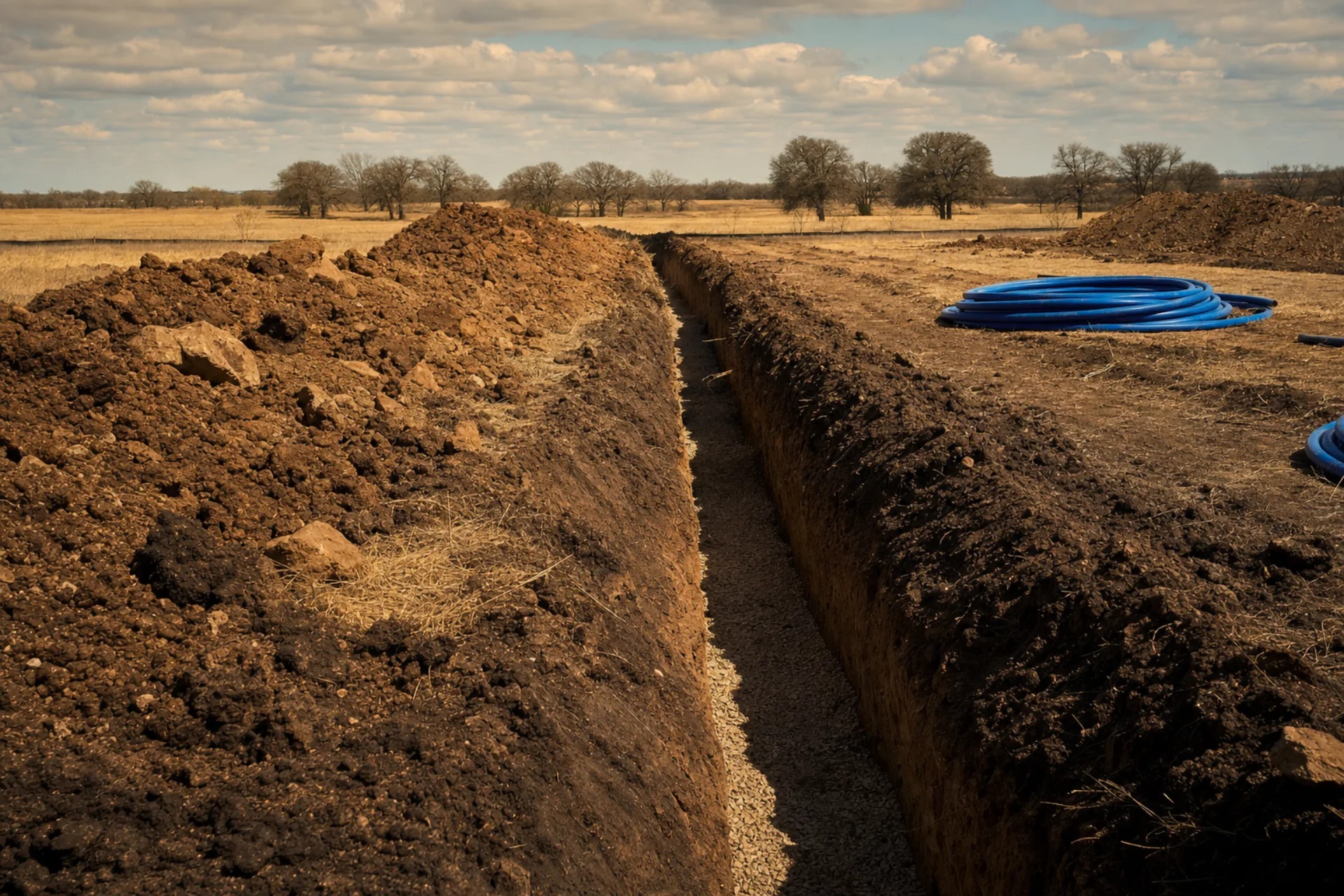
What we trench for
Water and sewer service lines. Electrical and gas laterals. Communication and fiber runs. Footing trenches for retaining walls, fence posts, and outbuildings. French drains and subsurface drainage systems. Irrigation mains. Anything that goes in the ground on a long line.
Depth and bedding. Where trenches go wrong.
A trench that looks fine on day one is a problem in year five when the line settles, cracks, or the ground over it heaves in blackland clay. The fix is upstream: dig to the right depth for frost and code, bed the line in the right material (sand for most, pea gravel for French drains), and backfill in lifts with compaction. Not a single dump from the bucket.
French drains, specifically
French drains in North Texas solve a lot of foundation problems. Dig to two feet minimum, slope the invert toward daylight or a collection point, lay perforated pipe in gravel wrapped with filter fabric, backfill with more gravel and cap with topsoil or sod. Done right, water leaves the foundation instead of pooling against it.
Coordinating with the other trades
We work alongside plumbers, electricians, and HVAC crews on builds, digging to their stake line, leaving the trench open long enough for the inspection, then backfilling on their schedule. On jobs where the trench work comes with site excavation or pad prep, we run it all as one scope. One less vendor for the GC to manage.