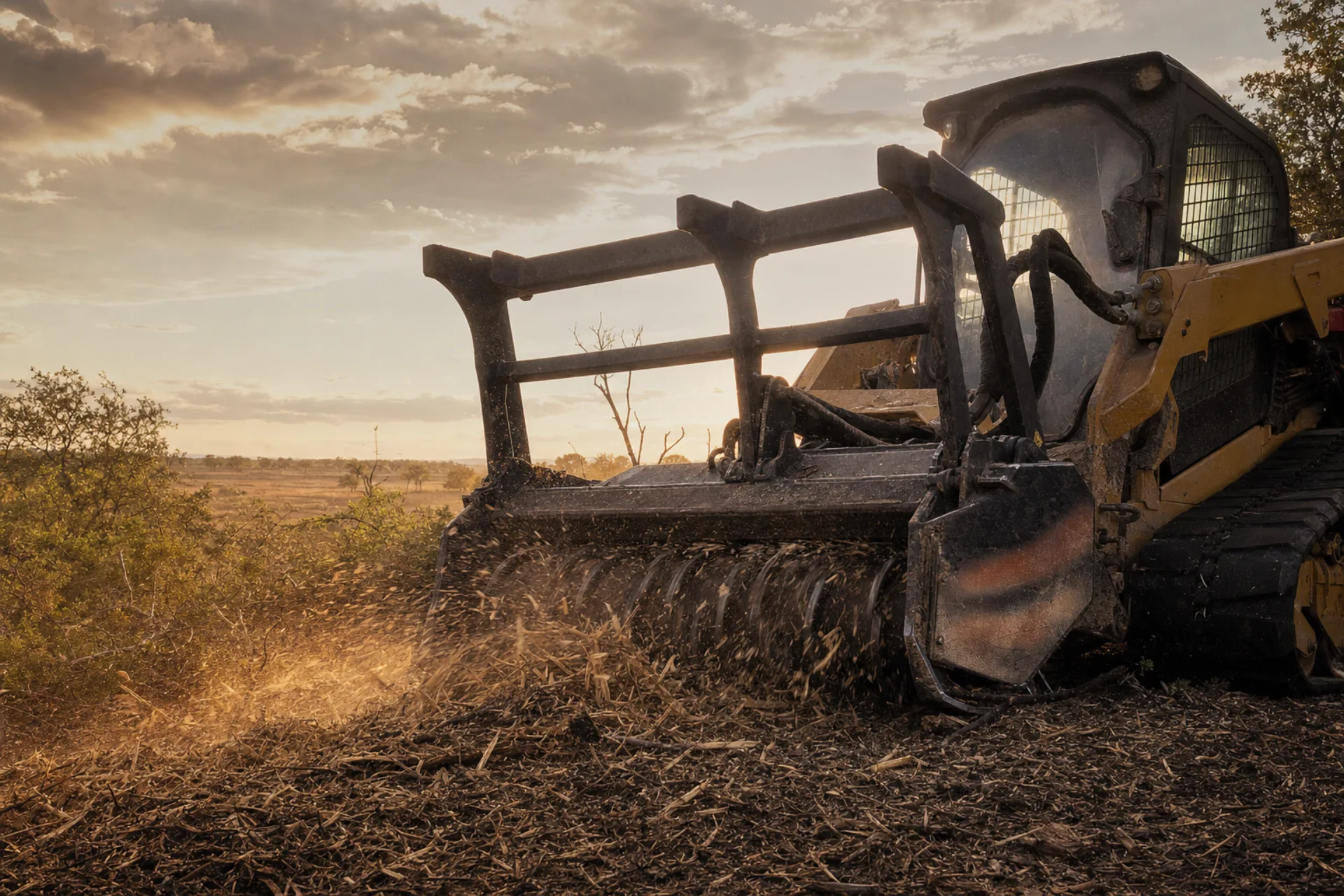
Forestry mulcher head on a skid steer grinding cedar and brush in a single pass

Forestry Mulching

Forestry Mulching in Dallas

Single-pass grinding that clears the scrub and feeds the soil. No burn piles, no haul-off, no torn-up ground.

What forestry mulching is

A rotary mulcher mounted on a skid steer, dozer, or excavator grinds trees, brush, and vegetation in a single pass, down to a flat layer of wood chips that stay on the ground. No piles, no burning, no debris hauls. The ground is ready to walk on and ready to seed.

When mulching beats traditional clearing

When you want to keep the soil intact. When you can't burn. When you're clearing around keeper trees, ponds, or structures. When hauling adds days of dump runs. When the land is going back into pasture, a food plot, or a trail system, the mulch layer suppresses weeds and builds topsoil as it breaks down. For a full side-by-side of the two methods, we wrote a mulching vs dozer clearing guide that walks through when each one wins.

What gets ground, what doesn't

Up to 8-inch stems go through in one pass. Larger trees like post oak, mature live oak, and big mesquite trunks we'll drop and grind separately, or leave as keepers on your call. Cedar-heavy tracts we handle as dedicated cedar removal work. Wire fence, concrete, and metal debris have to come out before we mulch. For whole-property jobs where mulching is part of a bigger scope, see our land clearing page. We walk the site with you first so nothing surprises the cutter.

After the job

The mulch layer is usually four to six inches deep, spread flat. It decomposes over the next twelve to eighteen months, returning nutrients to the soil. You can seed directly through it, run cattle on it once it settles, or let it mellow and come back next season with clean ground.

Forestry Mulching: common questions.

The stuff we get asked most. If yours isn't here, email us.

Expect $250 to $500 per hour depending on the machine and how thick the vegetation is, or $2,000 to $4,500 per acre on typical North Texas brush. Heavy cedar or post oak pushes the per-acre number up. We quote by the job after walking the ground.
Often, yes, once you count hauling, burn permits, and the second cleanup pass traditional clearing needs. Mulching is one pass, one crew, one invoice. On small lots with easy access it can be a wash; on acreage with tight budgets for dump fees, mulching usually wins.
Yes. Cedar is one of the best candidates for mulching. Ashe juniper grinds cleanly and the mulch actually breaks down faster than oak. For cedar-heavy tracts, we typically grind below the root crown so regrowth is minimized.
Up to 8-inch stems clean through in one pass. Larger trunks we drop and grind in a second pass. If your tract has heavy old-growth, send us a few photos before the visit so we bring the right machine the first time.
It stays on the ground in a four to six inch layer and breaks down over twelve to eighteen months, returning organic matter to the soil. You can seed straight through it, run cattle on it once it settles, or let it mellow and come back next season with cleaner ground.
Old-growth cedar and post oak. Tight or sloped access that caps machine size. Wire, concrete, or buried metal that has to come out before the cutter rolls. Hauling spoils off-site when the lot can't take the mulch (small urban lots, HOA restrictions). All flagged before we quote.

Get a mulching quote

Tell us about the tract and we'll be back same day with a number and a timeline.